


With a wardrobe, it's not taste that decides, but the folding rule. Most bad buys happen because someone plans the width and forgets the depth – and then the jackets hang crooked because two centimetres are missing. If you want to find the right wardrobe, you need three numbers: the niche width of your room, the available depth including the door opening, and your real storage needs. We go through all three in turn, with concrete measurements instead of vague rules of thumb. And we start where most people are too quick: with measuring.

Table of contents
- Before you buy: what your room really offers
- How deep does a wardrobe need to be?
- How much wardrobe width you need per person
- Interior layout: combining rails, shelves and drawers sensibly
- Height, doors and tricky rooms
- Which mokebo wardrobes suit which room
Before you buy: what your room really offers
Take the folding rule and measure the width of your space in three places: at the bottom by the floor, halfway up and at the top. Walls in older buildings are rarely straight, and the smallest of the three numbers is your real maximum width. Subtract another one to two centimetres of clearance, otherwise sliding it into place becomes precision work.
Then comes what many people overlook. Skirting boards run along almost every wall and keep the wardrobe one to two centimetres away – either you allow for this gap or you cut out the skirting board at that point. Radiators, windowsills, light switches and door stops count too. So don't just measure the wall, but the way there as well: does the wardrobe fit through your room door in individual parts?
For the height, you need two values. First, the room height minus about five centimetres of space at the top, so you can still dust up there. Second, the tilt height for assembly. If you assemble the carcass lying down and then stand it up, it briefly needs more space than its final height – with low ceilings, that gets tight. It's safer to assemble tall wardrobes standing up or to choose a model with a separate top unit.
Finally, the trick that saves you the most frustration: mark the outline of your dream wardrobe on the floor with masking tape. With hinged doors, draw in the opening radius as well, around 80 centimetres of clear space in front of the front. Then stand inside it and open the imaginary door. If you bump into the end of the bed, you know now and not after delivery.

How deep does a wardrobe need to be?
This is the point where most wardrobes fail – and of all things, very few guides are specific about depth. Yet the calculation is simple. A normal clothes hanger is around 45 centimetres wide. Add jacket sleeves, hoods or thicker winter coats and you need more like 60 centimetres. That's why a depth of between 58 and 60 centimetres has become the standard: the clothes hang across the rail, the door closes without resistance, nothing gets creased.
What is the ideal wardrobe depth? For a bedroom wardrobe in which shirts, dresses and coats are to hang, it's these 58 to 60 centimetres. Less is possible, but costs you comfort. At around 50 centimetres, the clothes rail no longer fits across, but has to be fitted lengthways – as a pull-out wardrobe lift on which things hang one behind the other. That works, but looks less clear and makes searching in the morning more awkward. Below 45 centimetres, nothing hangs properly any more. Such cupboards are purely for folded items or are chests of drawers – ideal for the hallway, unsuitable for the bedroom.
Conversely, more depth hardly helps. A 70-centimetre-deep wardrobe holds just as many hanging clothes as a 60 – the extra space ends up at the back, where you can't see it or reach it. It only costs you floor space. Ten centimetres of depth across the whole width of the room quickly adds up to half a square metre that you'll miss elsewhere.
Also factor the front into your planning. Handles stick out two to four centimetres, handleless push-to-open fronts don't. If your wardrobe stands in a niche or a door opens next to it, exactly this detail decides whether it fits.
How much wardrobe width you need per person
How much wardrobe is needed per person can be quantified surprisingly well. As a guide, allow about one cubic metre of storage per person – that roughly corresponds to a wardrobe section 100 centimetres wide, just under two metres high and 58 centimetres deep.
In practice, these values have proven themselves:
- For one person on their own, about 150 centimetres of width is comfortably enough.
- A couple should plan with at least 200 centimetres, 250 is more comfortable.
- Families with children's clothes and bedding in the same wardrobe quickly end up at 350 centimetres.
- For a child's room, 70 to 90 centimetres is enough, because children's clothes are shorter and you can fit shelves under the rail.

These figures are guidelines, not laws. Two things shift them significantly. First, your style of clothing: if you own lots of long dresses and coats, you need more hanging space and can manage with fewer shelves. If you mainly wear T-shirts and jeans, you fold most things and need shelf width rather than rail length. Second, the question of what else needs to go in. Bed linen, towels, suitcases and seasonal clothing easily take up half a metre of wardrobe width – if you have nowhere else for them, plan for it straight away.
If you're planning for two, take a look at our guide The perfect wardrobe for 2 people. There we go through how to divide the space between two people in detail.
An honest note to finish: don't buy bigger just in case. A modular system that you extend later by one element is the smarter answer to uncertain needs than an oversized wardrobe that overwhelms the room.
Interior layout: combining rails, shelves and drawers sensibly
The external dimensions determine how much fits in. The interior layout determines whether you find what you're looking for in the morning.
A three-way split works as a starting point. The middle zone at eye and grip level belongs to what you wear every day – a hanging rail for shirts and blouses, with open shelves for jumpers and tops directly below. At the very bottom goes what is heavy or rarely needed: shoe boxes, sports bags, suitcases. And at the very top you store seasonal items. Winter duvets, summer clothes in January, the guest bedding.
When it comes to the individual elements, it pays to be honest with yourself:
- A clothes rail needs around 100 centimetres of height for shirts and jackets. Dresses and coats need more like 150 centimetres. If you have both, divide the wardrobe vertically instead of putting one rail at a compromise height.
- Shelves for folded clothes work best at 30 to 35 centimetres high. Taller shelves tempt you to build towers that collapse when you pull out the bottom item.
- Drawers are the place for everything small: underwear, socks, belts, jewellery. In open shelves, these things get lost immediately. A soft-close runner makes the difference between a piece of furniture that sticks after two years and one that runs like on the first day.
Better to plan one zone too few than too many. A wardrobe with twelve miniature compartments looks tidy in the brochure and is a puzzle in everyday life. Two generous areas that you can clearly assign stay tidy for longer.
Height, doors and tricky rooms
For the height, you have two sensible options. A wardrobe around 190 centimetres fits practically anywhere, is easy to assemble and you can reach everything without a stool. A floor-to-ceiling wardrobe around 230 centimetres, on the other hand, gets significantly more storage out of the same footprint – and there's no dusty ledge at the top. If you're unsure, a system with a top unit you can add later is the relaxed solution: you start low and build up when space gets tight.
With doors, it's less about looks and more about the centimetres in front of the wardrobe. Hinged doors need an opening radius of around 80 centimetres, but give you a full view into the wardrobe and don't cost any depth inside. Sliding doors need zero space in front, but lose a few centimetres inside for the track and only ever reveal one half of the wardrobe. Rule of thumb: in tight bedrooms where the bed is close in front of the wardrobe, sliding doors win. Everywhere else, hinged doors are the more practical choice.
That leaves the difficult rooms. Under a sloping ceiling, measure the usable height at the point where the front edge of the wardrobe will stand – not at the wall. Often only a low wardrobe fits there, but you can go wider instead. In room corners, a narrow module 45 to 50 centimetres wide is worthwhile to fill the leftover strip instead of leaving the corner empty. And in small rooms, a light wardrobe in beige or white looks noticeably lighter than a dark one because it shows fewer edges.
Which mokebo wardrobes suit which room
At mokebo you'll find modular wardrobes that you adapt to your room instead of the other way round. Both systems are 58 centimetres deep – enough for your clothes to hang across on normal hangers without the door pressing against them. They are made in Germany and delivered by parcel service to your front door.

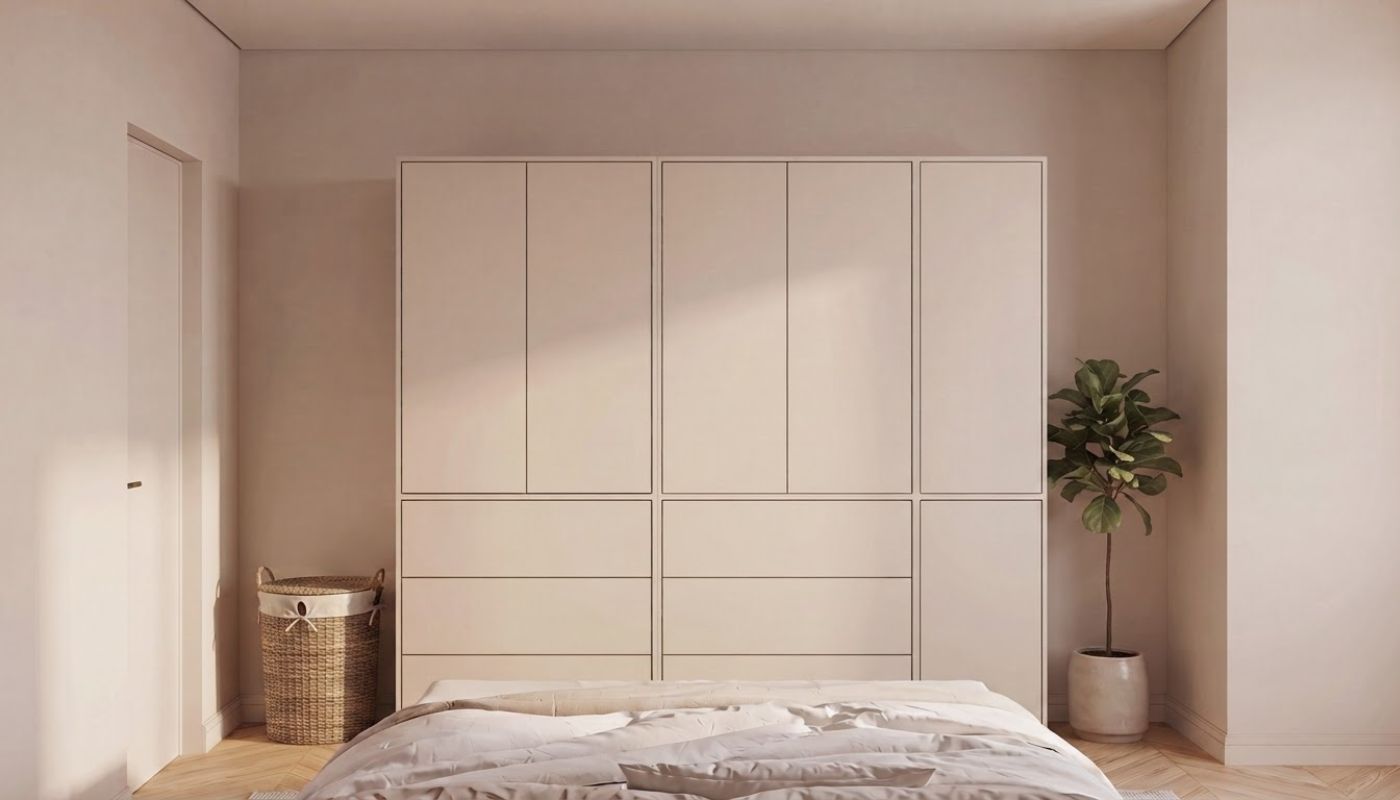
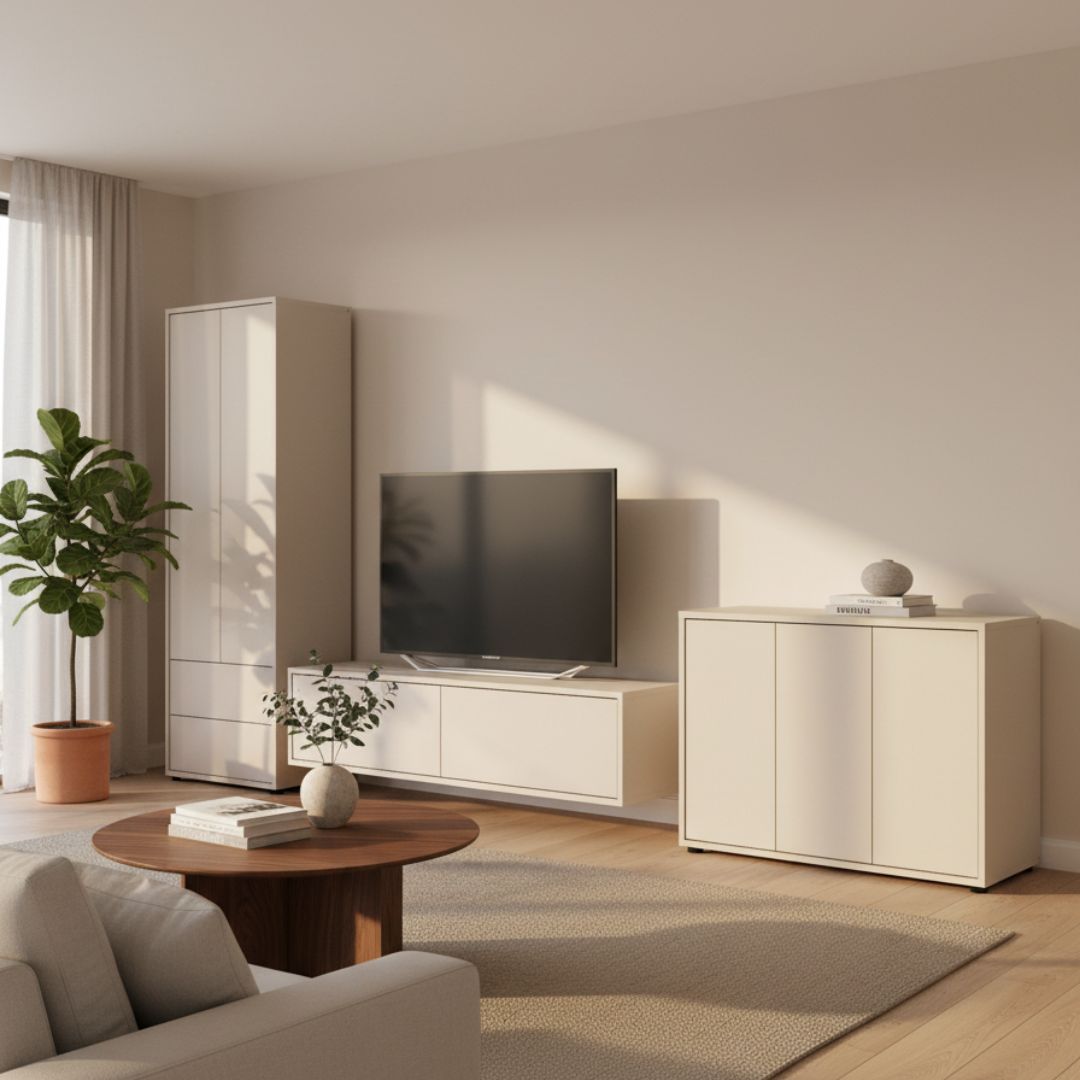
The wardrobe 'Robe' is the wardrobe for everyone who likes things calm. The handleless fronts in Kaschmir-Beige open with push-to-open, a light press is all it takes. With 20 millimetre panels and soft-close runners, it is the more solid of the two systems, and widths from 46 to 225 centimetres cover every situation – from a narrow module in a niche to a wall of wardrobes for two people. Available in a height of 197 or 234 centimetres, depending on whether you want to go up to the ceiling or not.
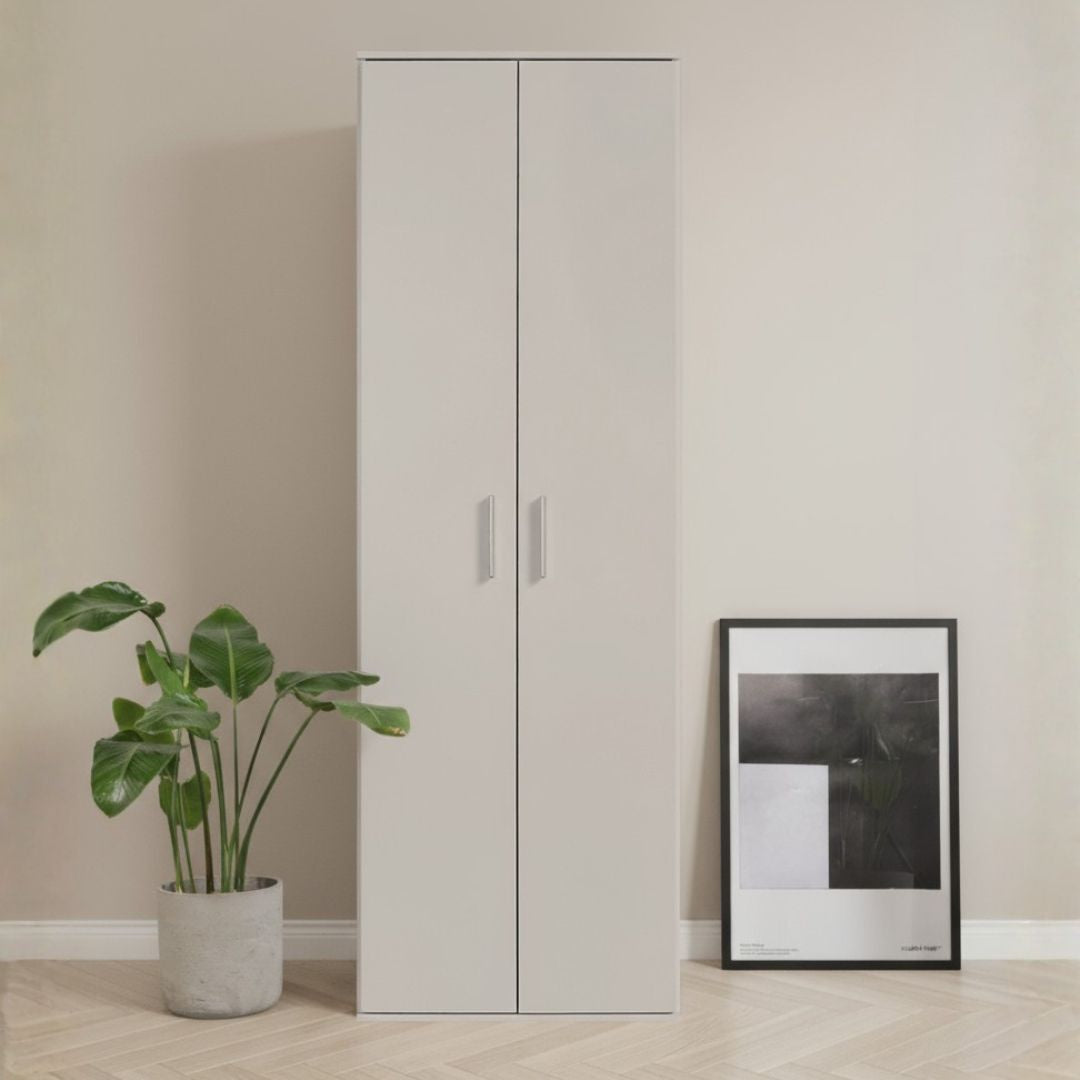
The wardrobe 'Grid' is the more classic version with hinged doors and handles, available in white and anthracite. With widths from 90 to 180 centimetres and heights from 187 to 234 centimetres, it matches typical bedroom dimensions, and anthracite is the colour many people look for in a room with light walls. 'Grid' is also modular, so you combine the modules that suit your wall.
Which of the two systems suits you better depends mainly on the look, panel thickness and available widths. We compare the differences in detail in the big wardrobe comparison: 'Robe' or 'Grid'.
A tip from experience: if you've just moved into a flat and don't yet know how much storage you really need, start narrower and add a module later. That's a much cheaper correction than a wardrobe that's too big and that you'll take apart again in two years. And order a wood sample first – beige and white look completely different depending on the light in the room.